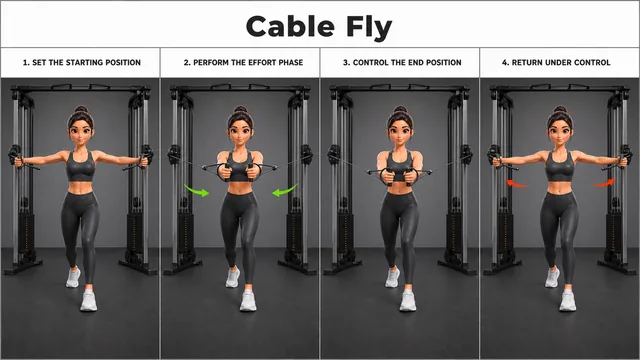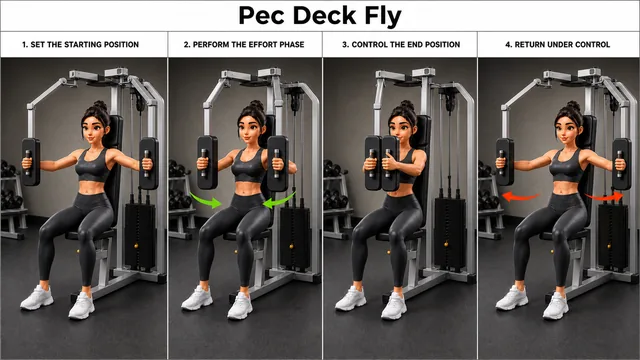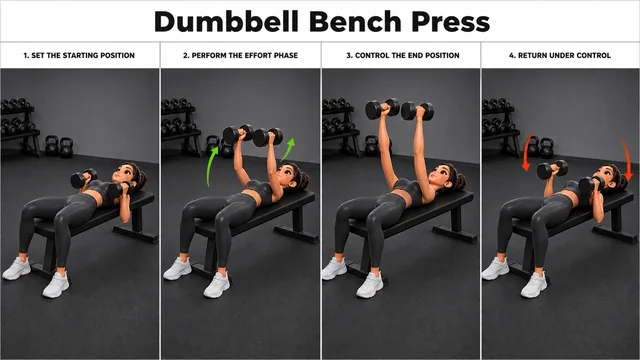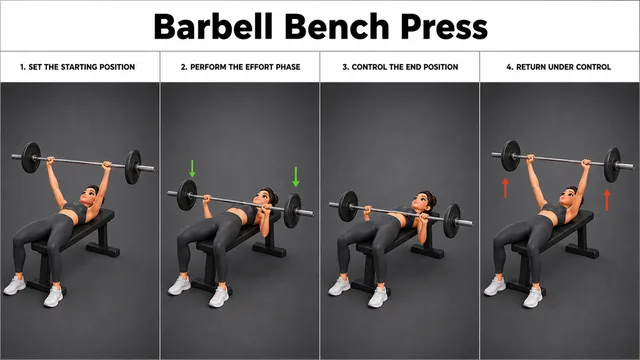
A strong Dumbbell Fly repetition begins before you move: the setup determines whether the right muscles can do their job. The exercise mainly trains middle chest and inner chest, while front delts and biceps stabilizers help support and control the movement. You will use a flat bench and a pair of dumbbells while working from supine on flat bench.
What makes a good Dumbbell Fly repetition?
Keep the shoulders organized while the chest and arms move through a repeatable pressing or fly path. The movement has a clear, scalable pattern. Start light, learn the positions in order, and progress only while every repetition remains controlled.
Muscles worked
Primary
Middle chest and Inner chest
These muscles should carry most of the intended work when the setup and movement path stay consistent.
Supporting
Front delts and Biceps stabilizers
These muscles assist the movement or help keep the rest of your position steady.
Set up before you move
Start from supine on flat bench. Use the prescribed grip: neutral. Check that a flat bench and a pair of dumbbells are secure and adjusted before you begin.
Step-by-step tutorial
How to do Dumbbell Fly
- 1
Hold above the chest
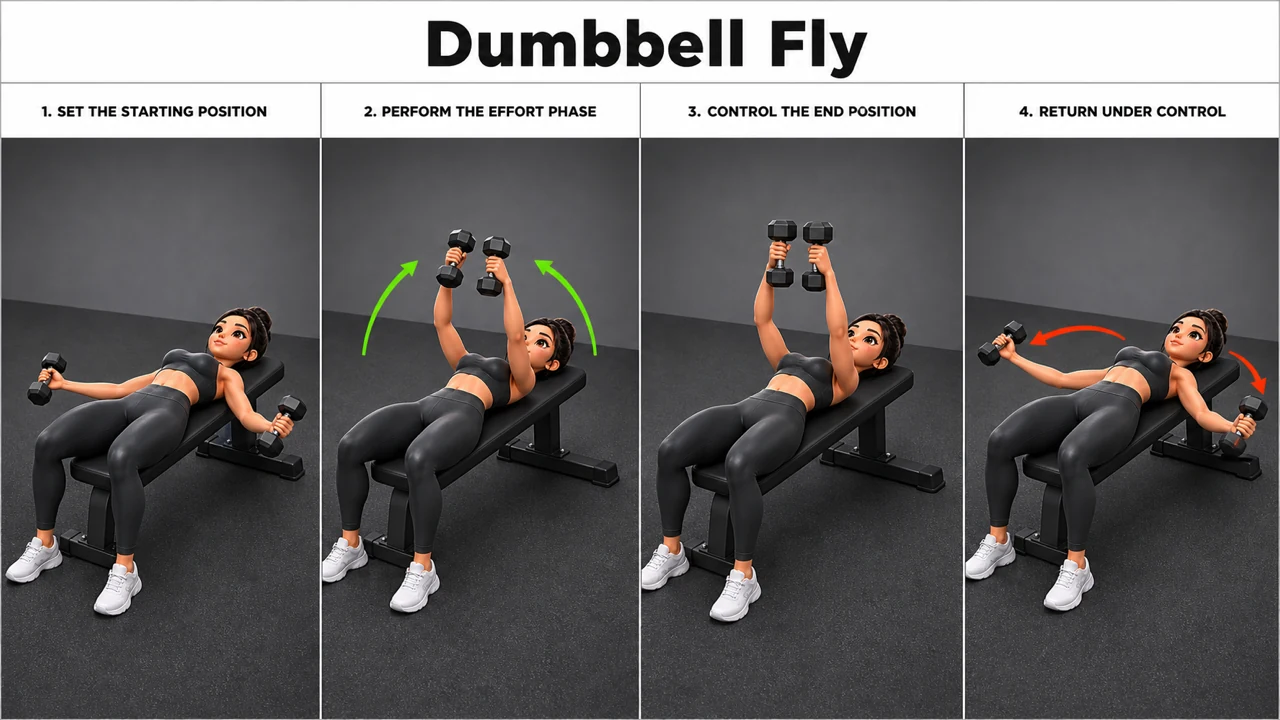
Lie on the bench and hold both dumbbells above the chest with palms facing inward and elbows softly bent.
Breathing: Breathe steadily; do not hold your breath.
- 2
Open the arc
Inhale and lower the arms out to the sides in a wide arc while keeping the elbow angle nearly fixed.
Breathing: Inhale through the controlled return.
- 3
Close the arc
Exhale and bring the dumbbells back over the chest as if hugging a large barrel.
Breathing: Exhale through the effort.
Common mistakes to avoid
Starting before the setup is stable
Do not rush the first position. Lie on the bench and hold both dumbbells above the chest with palms facing inward and elbows softly bent. Make that setup feel repeatable before adding speed or resistance.
Letting the working position drift
Keep your supine on flat bench setup consistent through the rep and maintain the neutral. If another part of the body has to swing or twist, reduce the load or range.
Rushing the return
The return is part of the exercise, not a pause between efforts. Inhale and lower the arms out to the sides in a wide arc while keeping the elbow angle nearly fixed.
Sets, reps, and rest
Start with 2–4 sets of 10–15 smooth repetitions. Rest 45–90 seconds between sets. Use enough resistance to feel the target muscles without shortening the range or borrowing momentum from the rest of your body.
Treat this as a starting framework. Your load and volume should match your current technique, recovery, and training plan.
Dumbbell Fly questions
Is Dumbbell Fly suitable for beginners?
Dumbbell Fly is classified as a beginner-level movement in this guide. The movement has a clear, scalable pattern. Start light, learn the positions in order, and progress only while every repetition remains controlled.
What muscles does Dumbbell Fly work?
Dumbbell Fly primarily works middle chest and inner chest, with front delts and biceps stabilizers assisting or stabilizing the movement.
What equipment do I need for Dumbbell Fly?
You need a flat bench and a pair of dumbbells. Set everything up securely before the first repetition.